Click Spark

Hire a Forward Deployed Engineer

Hire a Click Spark forward deployed engineer to take ownership of a business-critical integration, migration, custom software, workflow automation, or AI-enabled operations project. We can deploy one of our senior, customer-facing engineers into an approved engagement within 14 days, from discovery through production.

The Click Spark engineer assigned to your project works directly with your leadership, operators, technology teams, and vendors to turn the intended outcome into a system people can use. We can start with Salesforce, a CRM migration, a POS or ERP integration, a customer portal, reporting, or an operational workflow that has outgrown spreadsheets and manual coordination.

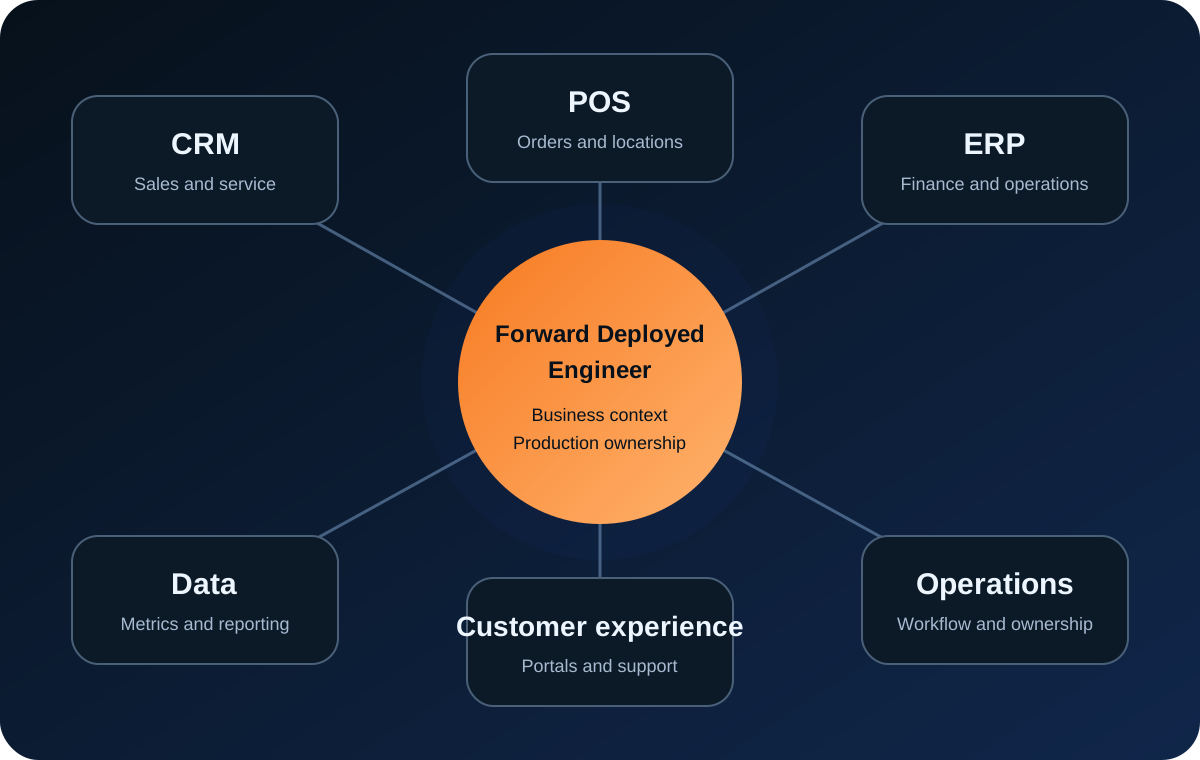
Forward deployed engineer connecting CRM, POS, ERP, data, customer experiences, and operational teams.
One accountable technical owner across business context, systems, deployment, and adoption.

Your most important software project needs an owner who can cross the gaps.

A company rarely struggles because nobody can name another tool. It struggles because customer data lives in one system, transactions live in another, the operating process lives in employee memory, and every change crosses several teams that were never designed to move together.

A CRM migration is not only a data import. It changes how sales qualifies an opportunity, how marketing identifies a customer, how service sees an order, how finance recognizes a payment, and how leadership measures the pipeline. A POS integration is not only a connector. It affects products, locations, inventory, refunds, loyalty, taxes, customer identity, and the reports used to run the business.

Traditional project structures often split that reality into separate statements of work. A strategist documents the future. A vendor configures one platform. A developer builds one interface. An analyst cleans one export. An internal manager tries to connect the pieces while still doing a full-time job. Every handoff loses assumptions, urgency, and accountability.

A Click Spark forward deployed engineer stays close to the real operating environment. They can sit with the person who works the process, inspect the systems, map the data, test the API, write the integration, configure the automation, surface the exception, and explain the tradeoff to the executive sponsor. The same person helps define success and stays present when the system meets production.

This model is built for established businesses that need senior execution without spending months recruiting a narrowly defined role. It is especially valuable when the work spans revenue, customer experience, operations, finance, data, and software at the same time.

Move from roadmap to production

A forward deployed engineer owns the path from discovery through architecture, implementation, testing, rollout, and adoption. Your team gets a working system instead of another document that waits for someone else to execute.

Connect the systems you already paid for

We work around the platforms that already run the business. The goal is to make Salesforce, your ERP, your POS, your website, and your operational tools exchange useful information without creating a fragile maze.

Reduce handoff loss

One technical owner stays close to leadership, operators, vendors, and developers. Decisions keep their business context as they move from a meeting into code, configuration, data, training, and measurable use.

Create momentum in uncertain work

Complex integration and migration projects always reveal unknowns. An embedded engineer can investigate them in the real environment, sequence the risks, and keep the project moving instead of waiting for a perfect specification.

Protect daily operations

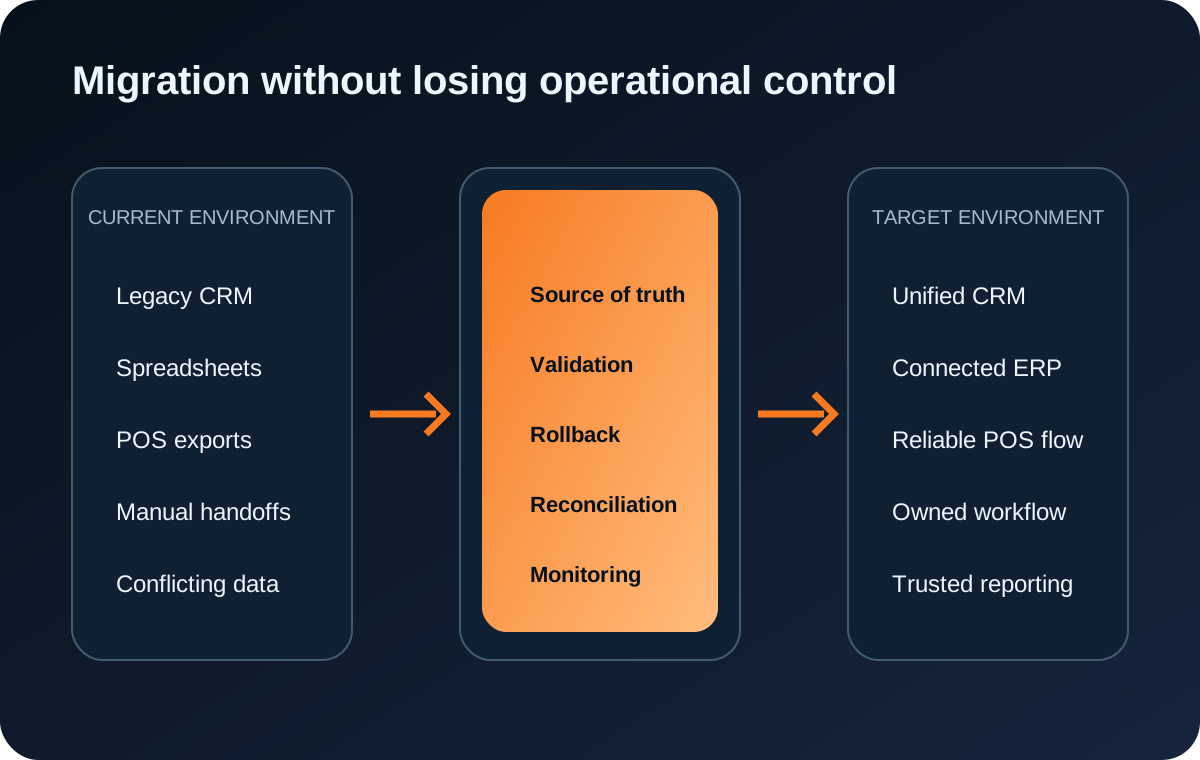
Migration and integration work is planned around the business that must keep running. We define rollback paths, validation checks, access controls, cutover windows, and human ownership before a critical workflow changes.

Leave a stronger internal system

The engagement should produce more than a launch. We document architecture, data ownership, operational rules, monitoring, support responsibilities, and the next priorities so the company is less dependent on tribal knowledge.

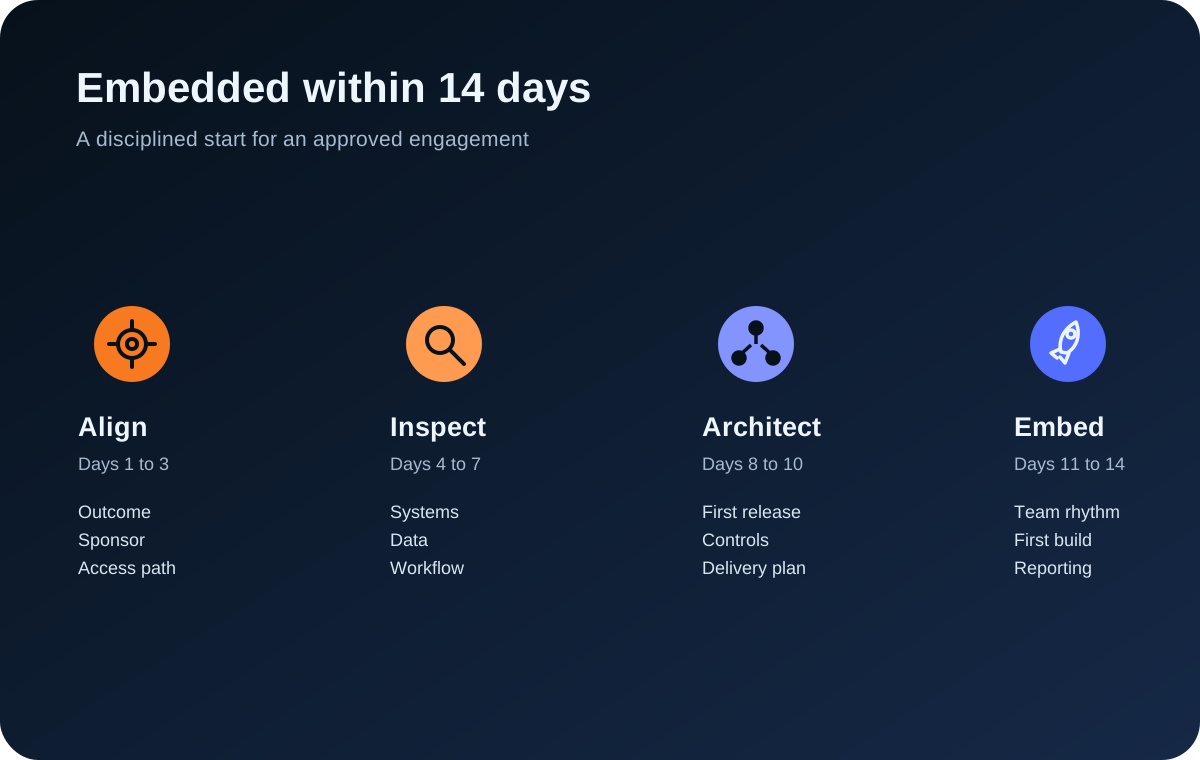
An engineer can be embedded within 14 days.

Speed comes from starting with the business outcome and assigning one accountable technical lead. It does not come from skipping access, security, data validation, or operational reality.

Fourteen-day forward deployed engineer onboarding and deployment plan.
A practical path from executive alignment to an embedded engineer and an active first implementation slice.
  1. Days 1 to 3

    Align on the business outcome, executive sponsor, operating owners, current systems, access requirements, deadlines, constraints, and the first production milestone.

  2. Days 4 to 7

    Inspect the actual workflow and data. Confirm API access, platform editions, objects, records, permissions, environments, vendors, failure points, and dependencies.

  3. Days 8 to 10

    Choose the integration or migration architecture, define the first release, establish security and rollback controls, and convert unknowns into a working delivery plan.

  4. Days 11 to 14

    Embed the engineer into the agreed team rhythm, begin the first implementation slice, stand up reporting, and show stakeholders what is moving next.

What the 14-day commitment means

We can place the engineer into an approved engagement within 14 days after the sponsor, scope, and start readiness are confirmed. It is an embedded-start commitment, not a promise that every migration or integration will be completed in 14 days. The first release is sized after the engineer validates the systems, risks, data, and dependencies.

Connect the customer journey to the operating truth.

The valuable work usually lives between platforms. A lead becomes an opportunity. An opportunity becomes an order. An order affects inventory, fulfillment, service, billing, retention, and reporting. A forward deployed engineer designs that chain as one operating system.

Click Spark begins by deciding what each system should own. Salesforce may own the opportunity and account relationship. The POS may own the completed in-person transaction. The ERP may own inventory and fulfillment. The accounting platform may own the approved financial record. The website or customer portal may own the experience through which a person makes a request. Those boundaries must be explicit before data starts moving.

Next, we define the events that matter. A qualified lead, approved quote, closed sale, paid order, refunded transaction, fulfilled job, opened support case, changed subscription, or completed appointment may need to create an action elsewhere. Each event needs an identifier, a data contract, a timing expectation, an error path, and a human owner when automation cannot complete safely.

Then we select the integration approach. Native automation can be the right choice when the workflow is supported, visible, and maintainable. Middleware can help when several systems need orchestration, transformations, retries, and monitoring. Custom services are appropriate when the business needs unique logic, greater control, or an interface that packaged tools do not provide. The architecture follows the operating requirement instead of a preferred tool.

The engineer also designs how the system fails. Duplicate webhooks, expired credentials, vendor downtime, partial records, rate limits, deleted fields, time-zone differences, and human overrides are normal production conditions. Reliable work detects those conditions, records them, retries safely where appropriate, and gives a person enough context to resolve the exception.

System migration from fragmented legacy tools into governed CRM, POS, ERP, and reporting workflows.
Migration and integration are treated as an operating change with data ownership, validation, controls, and adoption.

Work across the major platforms already inside the business.

Many U.S. companies run a mix of CRM, ERP, service, commerce, POS, and accounting platforms. We can help assess, migrate, integrate, or extend systems such as the ten commonly encountered platforms below. Final scope always depends on the client edition, available APIs, vendor terms, security policy, and the condition of the data.

Salesforce

Connect sales, service, marketing, finance, fulfillment, and customer data through the appropriate REST, Bulk, GraphQL, event, or vendor-supported integration path. We can also help rationalize objects, fields, ownership, automation, and reporting before a migration makes old disorder more expensive.

HubSpot

Align contacts, companies, deals, lifecycle stages, marketing activity, forms, service workflows, and external systems. We help teams avoid duplicate records, conflicting field definitions, and automations that fire without a clear owner.

Microsoft Dynamics 365

Coordinate sales, customer service, finance, operations, Power Platform, Microsoft 365, and external applications. We can design the integration boundary, data mapping, permissions, workflow behavior, and phased rollout.

Oracle NetSuite

Connect CRM, orders, inventory, fulfillment, billing, revenue, purchasing, and financial records. We focus on transaction integrity, source-of-truth decisions, reconciliation, exception handling, and a cutover the finance team can trust.

SAP

Plan integrations and migrations around complex enterprise data, process ownership, security, and operational continuity. The first job is often to identify the smallest valuable boundary that can ship without pretending the entire landscape can change at once.

ServiceNow

Connect requests, incidents, assets, employees, customer operations, approvals, and engineering workflows. We clarify which system owns each status, who approves each action, and what must be visible across departments.

Shopify

Connect storefront activity with CRM, ERP, inventory, fulfillment, customer support, marketing, analytics, subscriptions, and finance. The architecture should protect the buying experience while giving operators reliable order and customer context.

Square

Unify in-person commerce, customers, products, locations, payments, inventory, loyalty, and reporting with the rest of the business. We account for location rules, offline realities, refunds, reconciliation, and customer identity.

Toast

Connect restaurant POS, menus, locations, orders, loyalty, gift cards, labor, marketing, delivery, reservations, and reporting where supported. We plan around service continuity because a restaurant cannot pause operations for a software experiment.

QuickBooks

Move approved customer, invoice, payment, expense, product, vendor, and reporting data without turning accounting into an unmonitored side effect. Finance retains review authority, reconciliation, and exception visibility.

Salesforce, HubSpot, Microsoft Dynamics 365, Oracle NetSuite, SAP, ServiceNow, Shopify, Square, Toast, and QuickBooks are trademarks of their respective owners. Their inclusion describes common client environments, not a certification, formal partnership, or promise that every product edition exposes the same integration capabilities.

Give the engineer a business problem, not a ticket queue.

The role creates the most value when it owns a measurable outcome across systems and stakeholders. The engagement areas below can stand alone or become connected releases in one broader transformation.

CRM migration and consolidation

Move from spreadsheets, a legacy CRM, or multiple disconnected instances into a controlled customer system. We define record ownership, clean and map data, plan coexistence, test migration batches, preserve critical history, and prepare users for the new operating model.

CRM, POS, and ERP integration

Connect what sales promised, what the customer bought, what operations fulfilled, what inventory changed, and what finance recognized. The objective is not maximum synchronization. It is the right information, in the right system, at the right time, with an accountable owner.

Workflow automation

Turn a manual process into a monitored system with explicit triggers, decisions, approvals, retries, exception queues, and human escalation. We can use native platform tools, integration platforms, custom services, or a combination selected for maintainability.

Customer portals and internal tools

Build the interface that closes the gap between systems. A portal, dashboard, intake tool, approval queue, or operational workspace can give customers and employees one clear place to act without replacing every system behind it.

Data and reporting foundations

Resolve metric definitions, identifiers, event timing, transformations, and reporting ownership before leaders are asked to trust a dashboard. We trace important numbers back to their source and make missing or late data visible.

AI-enabled operational systems

Introduce AI where it can improve classification, retrieval, drafting, analysis, or decision support inside a governed workflow. Permissions, evidence, approval, evaluation, monitoring, and fallback behavior are part of the production design.

How the embedded engagement works after day 14.

The engineer enters the company with a defined first outcome, a decision rhythm, and direct access to the people who own the process. Work advances in small production slices so the team can learn before the highest-risk cutover.

Discover in the real environment

We interview the people closest to the work, observe the process, inspect configuration and data, identify hidden dependencies, and establish a baseline. Documentation is useful, but the deployed reality is the source of truth.

Build the smallest valuable release

We choose a production slice that proves the architecture and creates visible value. It may be one location, one workflow, one customer segment, one integration direction, or one migrated data set with reconciliation.

Operate with controls

Permissions, approvals, logging, monitoring, retries, exception ownership, security review, and rollback are designed with the feature. The goal is a system the business can trust, not a demonstration that only works on the happy path.

Expand from evidence

Once the release is stable, the engineer measures use, business impact, failures, and support demand. That evidence determines whether to expand, redesign, transfer ownership, or stop before more complexity is added.

Governance is practical and visible. Access follows least privilege. Production changes have named approvers. Sensitive data is limited to what the workflow requires. AI-assisted features include the right evidence, evaluation, approval, and fallback behavior for their risk. Logs and dashboards answer what happened, what failed, who acted, and what should happen next.

Adoption is part of engineering. A technically correct system can still fail if the team does not understand the workflow, trust the data, or know what to do with exceptions. We include operating documentation, role-based training, launch support, and feedback from the people who use the system. The software is not finished when it deploys. It is finished when the intended process can run reliably.

Knowledge transfer is also designed from the beginning. Architecture decisions, integration contracts, field mappings, environments, credentials ownership, deployment steps, monitoring, known limits, and support paths are documented. If Click Spark remains involved, that documentation keeps the managed cadence efficient. If ownership transfers, the internal team receives a system it can reason about.

Where a forward deployed engineer can create immediate leverage.

The model works across industries because the core challenge is consistent: important value crosses software, data, teams, vendors, and customer moments. The implementation remains specific to the business.

Multi-location and franchise businesses

Connect location-level POS, inventory, calls, leads, bookings, reviews, labor, marketing, and finance without losing local accountability. A forward deployed engineer can create one repeatable rollout pattern, prove it in a small group, then expand with evidence.

Professional services

Join lead intake, qualification, scheduling, proposals, project delivery, billing, and client communication. The result can be a clearer path from first inquiry to active engagement, with fewer dropped handoffs and better leadership visibility.

E-commerce and retail

Coordinate storefront, marketplace, POS, inventory, fulfillment, returns, service, lifecycle marketing, subscriptions, finance, and analytics. The engineer works across customer experience and operational truth instead of optimizing one screen in isolation.

Restaurants and hospitality

Connect reservations, guest profiles, POS, loyalty, delivery, events, support, reviews, labor, and reporting. Releases are planned around operating hours, location differences, vendor limits, and the guest experience.

Financial and investment firms

Improve controlled intake, research, document workflows, approvals, reporting, client communication, and internal systems while respecting access boundaries, auditability, and human decision authority.

Established founder-led companies

Translate years of practical business knowledge into systems that a growing team can operate. The engineer can work directly with the owner and the people closest to the process, then turn that knowledge into durable workflows and software.

Forward deployed engineer questions, answered.

Clear answers about fit, timing, integrations, risk, and what it means to put an engineer inside the business problem.

What is a forward deployed engineer?

A forward deployed engineer is a customer-facing engineer who works inside a real business problem from discovery through production. The role combines technical architecture, hands-on implementation, operational judgment, stakeholder communication, rollout, and adoption.

Can Click Spark deploy an engineer within 14 days?

Yes, for an approved engagement with a confirmed sponsor, accessible stakeholders, and a workable access path, Click Spark can place a forward deployed engineer into the project within 14 days. The first production milestone depends on scope, platform access, vendor limits, security review, and data readiness.

Do you work with Salesforce integrations and migrations?

Yes. We can help assess Salesforce architecture, data, objects, permissions, automation, reporting, connected systems, migration requirements, and API options. Available approaches depend on the Salesforce edition, enabled API access, security policy, and the systems being connected.

Can you integrate our CRM with our POS and accounting software?

Often, yes. We begin by defining which system owns customers, products, orders, payments, inventory, taxes, refunds, and financial records. We then choose supported APIs, connectors, middleware, or custom services and design monitoring, reconciliation, and exception handling.

Will the engineer replace our internal IT or software team?

No. The engineer can lead a defined deployment, fill a temporary capability gap, accelerate an internal team, or coordinate vendors. Internal owners remain important because the company must operate and govern the system after launch.

Do you use native tools, middleware, or custom code?

We use the simplest approach that can meet the business, security, reliability, and ownership requirements. That may be native platform automation, an integration platform, a custom service, or a deliberate combination. We do not force every problem into one tool.

How do you protect the business during a migration?

We define source-of-truth rules, backups, test batches, validation criteria, access controls, cutover steps, rollback options, reconciliation, and post-launch monitoring. High-risk actions require named human approval.

What does a forward deployed engineer engagement cost?

Pricing depends on the systems, risk, urgency, data condition, number of stakeholders, and expected ownership. Click Spark scopes the first production outcome and the embedded capacity required after a demo and technical discovery call.

What companies are the best fit?

The best fit is an established company with a valuable operational problem, an executive sponsor, people who understand the current process, and willingness to provide responsible access. Custom engagements are designed for businesses generating at least $50K in monthly revenue.

What happens after the first release?

We measure adoption, reliability, cycle time, data quality, exceptions, customer impact, and the business outcome. Click Spark can stabilize the system, transfer ownership, continue with a managed engineering cadence, or plan the next deployment.

Put a forward deployed engineer on the problem that matters.

Tell us what needs to move, which systems are involved, and what the business cannot afford to break. We can scope the first production outcome and prepare an approved engineer to embed within 14 days.

Book a Demo Call