
The direct definition
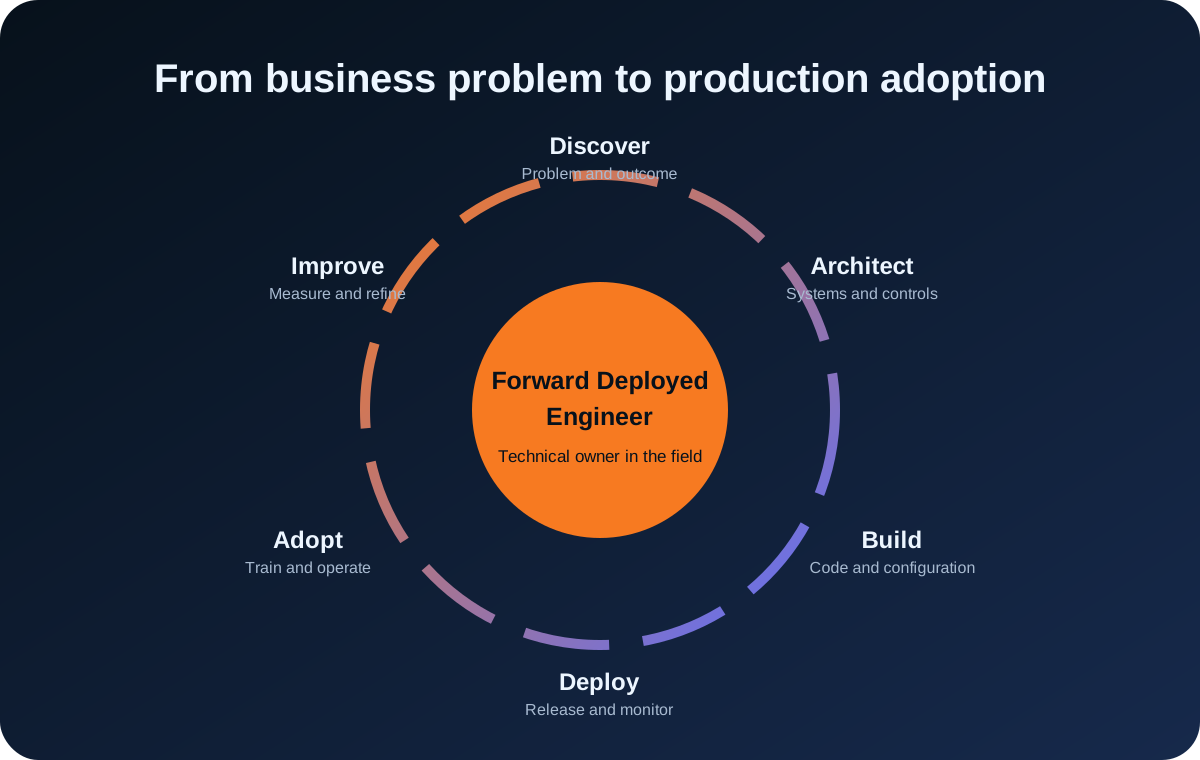
A forward deployed engineer is an engineer embedded close to a customer, business unit, or operating team to deliver a specific technical outcome. The role blends the responsibilities of a software engineer, solutions architect, technical product lead, implementation specialist, and deployment owner. The exact mix changes with the problem, but the center of gravity stays the same: understand the customer’s environment, make sound technical decisions, contribute directly to the build, and remain accountable when the solution reaches real users.
The word forward describes proximity. The engineer moves toward the point where technology meets the operating reality of the customer. The word deployed describes the delivery posture. This is not an engineer waiting for perfectly prepared requirements inside a distant backlog. The engineer works with incomplete information, discovers what matters, and helps the organization reach a stable production state.
The role became widely associated with companies such as Palantir, where technical teams worked closely with complex customer environments. It has expanded across enterprise software, data platforms, infrastructure, cybersecurity, and artificial intelligence. A current OpenAI description of forward deployed engineering emphasizes end-to-end deployments, customer engineering partnership, production adoption, measurable workflow impact, and feedback that improves the underlying product. Those themes capture the core model even when the technology and industry are different.
Why companies use forward deployed engineers
Important technical programs rarely fail because a team cannot write any code. They fail because the business problem is split across ownership boundaries. Sales knows why the CRM does not match the real pipeline. Operations knows which exceptions break the process. Finance knows which number can be trusted. IT knows the access and security limits. A software vendor knows its own product. An outside developer knows the application being built. Nobody has enough context or authority to connect all of it.
A forward deployed engineer reduces that fragmentation. They become a technical point of ownership who can move between a leadership discussion, an operator’s screen, an API response, a data model, a code review, a vendor call, and a rollout plan without treating those as separate projects. This does not mean one person knows everything. It means one person is accountable for finding the right expert, preserving the context, and advancing the production outcome.
The model is also useful when the requirements are uncertain. A legacy migration may reveal undocumented fields, duplicate identities, manual corrections, and reports built around old behavior. An AI workflow may appear simple until permissions, evidence, exceptions, and human review are considered. A POS and CRM integration may uncover that locations define products differently or that online and in-person customers cannot be matched safely. The FDE expects discovery to continue during delivery.
That expectation changes the plan. Instead of attempting one large specification followed by one large launch, the engineer finds the smallest valuable production slice. The team proves the architecture, validates the data, measures the workflow, and learns where the next risk lives. Progress becomes a series of controlled releases rather than a long period of hidden activity.
How a forward deployed engineer differs from adjacent roles
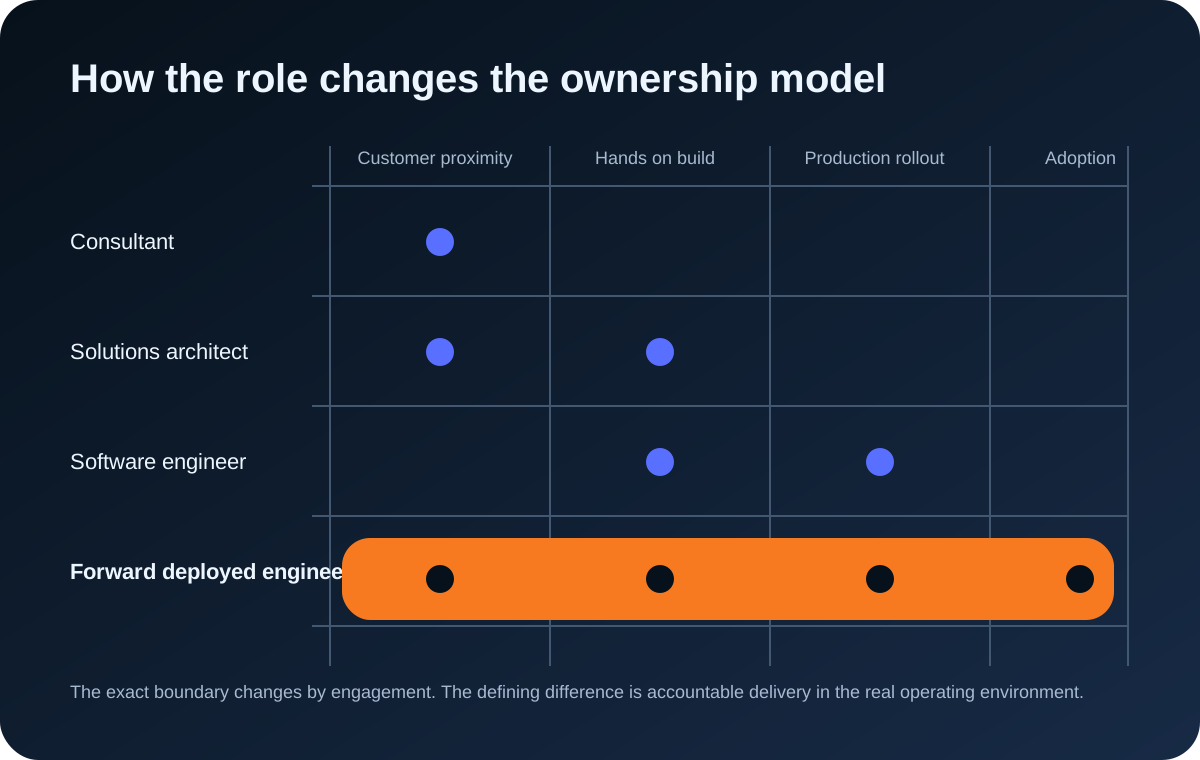
Job titles are imperfect. A strong software engineer, consultant, solutions architect, or technical leader may already work in a forward deployed way. The useful distinction is not prestige. It is the operating contract around proximity, implementation, and outcome ownership.
Traditional software engineer
Usually owns software quality and delivery inside a defined product or engineering organization. A forward deployed engineer also works directly with the customer environment, business workflow, adoption, and cross-functional decisions.
Solutions architect
Often defines a sound architecture and guides implementation. A forward deployed engineer may perform that work, but also writes or configures the production system and stays accountable through rollout.
Implementation consultant
Often configures a specific platform through an established methodology. A forward deployed engineer can cross products, build custom code, redesign the workflow, and resolve gaps that do not fit one vendor playbook.
Technical project manager
Coordinates scope, schedule, dependencies, and communication. A forward deployed engineer does those things when needed, but also makes technical decisions and contributes directly to the implementation.
Fractional CTO
Provides executive technology direction, prioritization, and governance. A forward deployed engineer operates closer to a defined deployment and owns the path from technical discovery to a working production outcome.
Systems integrator
Connects applications and data through implementation services. Forward deployed engineering adds deeper proximity to the operating problem, a product mindset, and responsibility for adoption and measurable workflow impact.
A forward deployed engineer should not become an unbounded technical assistant. The engagement still needs a defined business outcome, responsible sponsor, decision process, access model, and delivery boundary. The engineer may solve unexpected problems, but those decisions should protect the production objective rather than create a permanent queue of unrelated requests.
What a forward deployed engineer is responsible for
The role usually spans six connected responsibilities. The balance shifts by engagement, but removing any one of them can recreate the handoff problem the model is meant to solve.
Discover the real problem
The engineer works with executives, operators, subject-matter experts, and technical teams to understand the outcome, current workflow, constraints, and cost of failure. They test assumptions against the actual environment instead of treating the initial request as a complete specification.
Define the production scope
They translate the business problem into a technical boundary that can ship. That includes systems, data, users, permissions, environments, integration contracts, success measures, rollout stages, and what will intentionally remain outside the first release.
Design the architecture
They choose where logic belongs, how systems exchange data, which product owns each record, how identity and access work, and how the deployment will be monitored. The design balances immediate value with a maintainable ownership model.
Build and configure the system
A forward deployed engineer is hands-on. They may write application code, integration services, data transformations, tests, infrastructure, dashboards, or internal tools. They may also configure CRM, ERP, POS, workflow, and automation platforms when native capability is the better choice.
Coordinate decisions
Because the work crosses teams, the engineer makes tradeoffs visible. They explain what is blocked, what is risky, what can ship now, what requires approval, and what should wait. This keeps executives, users, vendors, and developers aligned around the same release.
Launch and improve
The engineer remains involved through testing, cutover, adoption, monitoring, and early production feedback. They measure whether the system changed the workflow and business outcome, then turn what the field teaches into the next release or a durable handoff.
These responsibilities explain why communication is a technical skill in forward deployed work. The engineer must translate without oversimplifying. An operator needs to know what will change in the daily workflow. An executive needs to know the business impact, risk, and decision. A security owner needs to know the access boundary and evidence. A developer needs an explicit contract, failure behavior, and test condition. All of them need to be describing the same system.
What the work looks like in CRM, POS, ERP, and data projects
Consider a company that uses Salesforce for sales, a POS for transactions, an ERP for inventory and fulfillment, an accounting platform for financial records, and separate tools for support and marketing. Each product may function correctly on its own while the customer journey remains broken. Sales cannot see the completed purchase. Service cannot see fulfillment. Marketing cannot distinguish a prospect from a returning customer. Finance corrects exceptions manually. Leadership reconciles reports in spreadsheets.
The FDE does not begin by connecting every field in every direction. They define the operating events and ownership rules. Which system creates the customer identifier? When does a lead become a customer? Which transaction is authoritative? How are refunds represented? What happens when the POS is offline? Which product owns inventory? When may marketing act on an event? Who resolves a record that cannot be matched?
With those answers, the engineer can select the appropriate API, event, connector, middleware, or custom service. Salesforce itself documents several API types for different needs, including REST, SOAP, Bulk, GraphQL, metadata, and event-oriented options. Its official API selection guide also notes that available access depends on the edition and use case. A responsible integration plan confirms those practical limits before committing to an architecture.
The same principle applies to HubSpot, Microsoft Dynamics 365, Oracle NetSuite, SAP, ServiceNow, Shopify, Square, Toast, QuickBooks, and industry-specific systems. Product names do not define the workflow. The business must still decide what information should move, why it should move, when it should move, who may see it, and what should happen when it cannot move.
The forward deployed engineering process
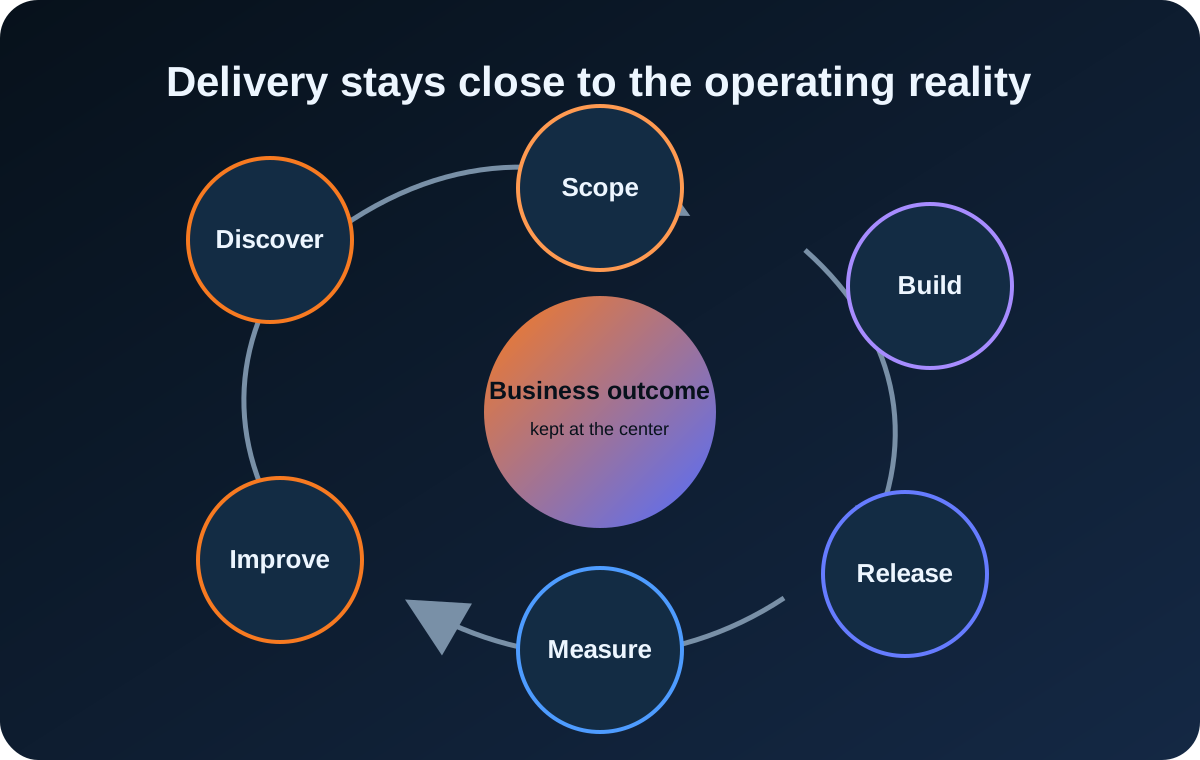
Start with an outcome and a sponsor
The project needs a business consequence that matters and a person who can make decisions. The desired outcome might be a shorter lead-response time, a reliable order handoff, one customer record, fewer manual reconciliations, faster onboarding, safer document processing, or a migration away from a system that limits growth. A named sponsor protects priorities and resolves decisions that cannot be made by engineering alone.
Observe the current workflow
The engineer talks with the people who execute and manage the process. They review screens, exports, automations, code, integrations, reports, permissions, incidents, and workarounds. This is where the team finds the difference between the documented process and the process that keeps the business running.
Define ownership and boundaries
Every important record, status, decision, and action needs an owner. The engineer defines which system is authoritative, which data may be copied, which user or service may act, and which events require human approval. The first release is bounded around the smallest end-to-end outcome that can create and demonstrate value.
Build with production conditions in mind
The implementation includes authentication, permissions, validation, idempotency, rate limits, retries, exception handling, observability, and rollback. The engineer tests normal behavior and edge cases with realistic data. Sensitive changes move through the required review and approval process.
Roll out in controlled stages
A release may begin with one team, location, workflow, customer segment, or integration direction. The FDE supports users, monitors the system, documents failures, and keeps the rollback path available until the new behavior is proven. Training and operating instructions are delivered alongside the software.
Measure impact and decide what comes next
Technical health matters, but the central question is whether the workflow improved. The team can measure cycle time, adoption, data completeness, exception volume, response time, conversion, support demand, reconciliation effort, and the business result defined at the beginning. Evidence determines the next release.
When a company should hire a forward deployed engineer
The model is strongest when technical complexity and organizational complexity appear together. A simple website update or a well-bounded platform configuration may not need an embedded engineer. A project that crosses customer experience, data, operations, finance, security, and several vendors often does.
- The project crosses several systems, teams, or vendors and nobody owns the whole outcome.
- A CRM, ERP, POS, commerce, service, accounting, or data migration has material operational risk.
- Leadership needs a working production result, not another strategy deck or disconnected technical estimate.
- The company has valuable domain knowledge but needs help translating it into software and repeatable workflows.
- Internal engineers are capable but overloaded, missing a specific integration skill, or too far from daily operators.
- A new AI capability must connect to permissions, evidence, approvals, monitoring, and real systems before it can create value.
- The requirements are uncertain because the team will learn only by working in the production environment.
- Several point solutions exist, but the customer and operating journey remains fragmented.
A company also needs to participate. The FDE can reduce ambiguity, but cannot invent the organization’s risk tolerance or operate without access to subject-matter experts. The best clients make knowledgeable people available, answer decisions, provide responsible system access, and allow a small release to teach the team before demanding a broad rollout.
How forward deployed engineering works with AI
AI has made the FDE model more visible because an impressive prototype is far from a dependable operating system. A production AI workflow must connect models to approved knowledge, applications, permissions, tools, evaluation, monitoring, escalation, and human accountability. The work often involves more than selecting a model or writing a prompt.
An embedded engineer can map where AI is appropriate, where deterministic rules are safer, what evidence a user needs, what actions require approval, and how the system should respond when confidence is low. They can build the retrieval, tool calls, user interface, audit record, evaluation set, and operational dashboard that make the capability reviewable.
The role also creates a valuable feedback path. Production use reveals which inputs are missing, which instructions are ambiguous, where users override the result, and which edge cases matter. The engineer can turn those field signals into better workflow design, software, evaluations, and product priorities without letting the system learn uncontrolled behavior from every interaction.
How to evaluate a forward deployed engineer
Look for breadth with judgment, not a claim to know every platform. The engineer should be able to investigate an unfamiliar system, read documentation, test an API, understand data, write production-quality code, communicate risk, and ask the business questions that change the architecture. They should know when to use a native feature, a connector, middleware, custom software, or no automation at all.
Ask how they have handled ambiguous requirements, production incidents, migration validation, access controls, conflicting stakeholders, adoption, and knowledge transfer. Ask how they decide the first release, what they monitor, and how they make rollback possible. A strong answer connects technical choices to the people who must operate the system.
Success should be measured by production adoption and business impact as well as delivery. Useful signals include time to first production value, workflow completion, reliability, exception volume, data quality, user adoption, manual effort removed, conversion, service speed, and the ability of the internal team to understand and operate what was built.
Questions about forward deployed engineers
What is a forward-deployed engineer in simple terms?
A forward-deployed engineer is a hands-on engineer who works directly with a customer to understand an important business problem, build the technical solution, launch it in the real environment, and help the organization adopt it.
Why is the role called forward deployed?
The phrase describes an engineer who works close to the customer and the operational edge of the problem instead of remaining only inside a centralized product team. The engineer brings field context back into technical decisions and reusable patterns.
Does a forward deployed engineer write code?
Yes, hands-on implementation is a core part of the role. Depending on the engagement, that can include application code, integrations, data pipelines, automation, tests, infrastructure, dashboards, platform configuration, and internal tools.
Is forward deployed engineering only for AI companies?
No. The model has become visible in AI because production AI deployments cross data, policy, workflow, evaluation, security, and adoption. The same model is valuable for CRM, ERP, POS, data, software, migration, and operational automation projects.
How is an FDE different from a consultant?
A consultant may primarily advise, assess, or recommend. A forward deployed engineer is expected to participate directly in technical delivery and remain accountable through production. Some strong consultants work this way, but the FDE title makes embedded engineering ownership explicit.
How long does a forward deployed engagement last?
It can range from a focused deployment to a long-running embedded partnership. The right duration depends on complexity, risk, internal ownership, adoption, and whether the company needs a single release, a migration program, or continuous delivery.
What should a company prepare before an FDE starts?
Name an executive sponsor, identify the people closest to the workflow, gather current documentation, list the systems and vendors involved, clarify access and security requirements, and define the first business outcome. Perfect documentation is not required.
How can we engage a forward deployed engineer from Click Spark?
Book a demo call and describe the problem, systems, timing, and business consequence. If the engagement is a fit and start readiness is confirmed, Click Spark can embed a forward deployed engineer within 14 days.
Move from the definition to a real deployment.
Click Spark can embed a forward deployed engineer into an approved project within 14 days. We work with established companies on CRM and POS integration, system migration, custom software, workflow automation, data, and governed AI operations. The engagement begins with the first measurable production outcome.
Explore the Forward Deployed Engineer service